
Situation
Operational load decisions are commonly related to ice thickness through empirical relationships, yet real ice covers also vary in quality, temperature, boundary support, load duration, load footprint and defect condition.
Ice Engineering · Bearing Capacity · Research
Re-examining floating-ice bearing capacity using field context, empirical guidance and plate-mechanics models.
Project overview
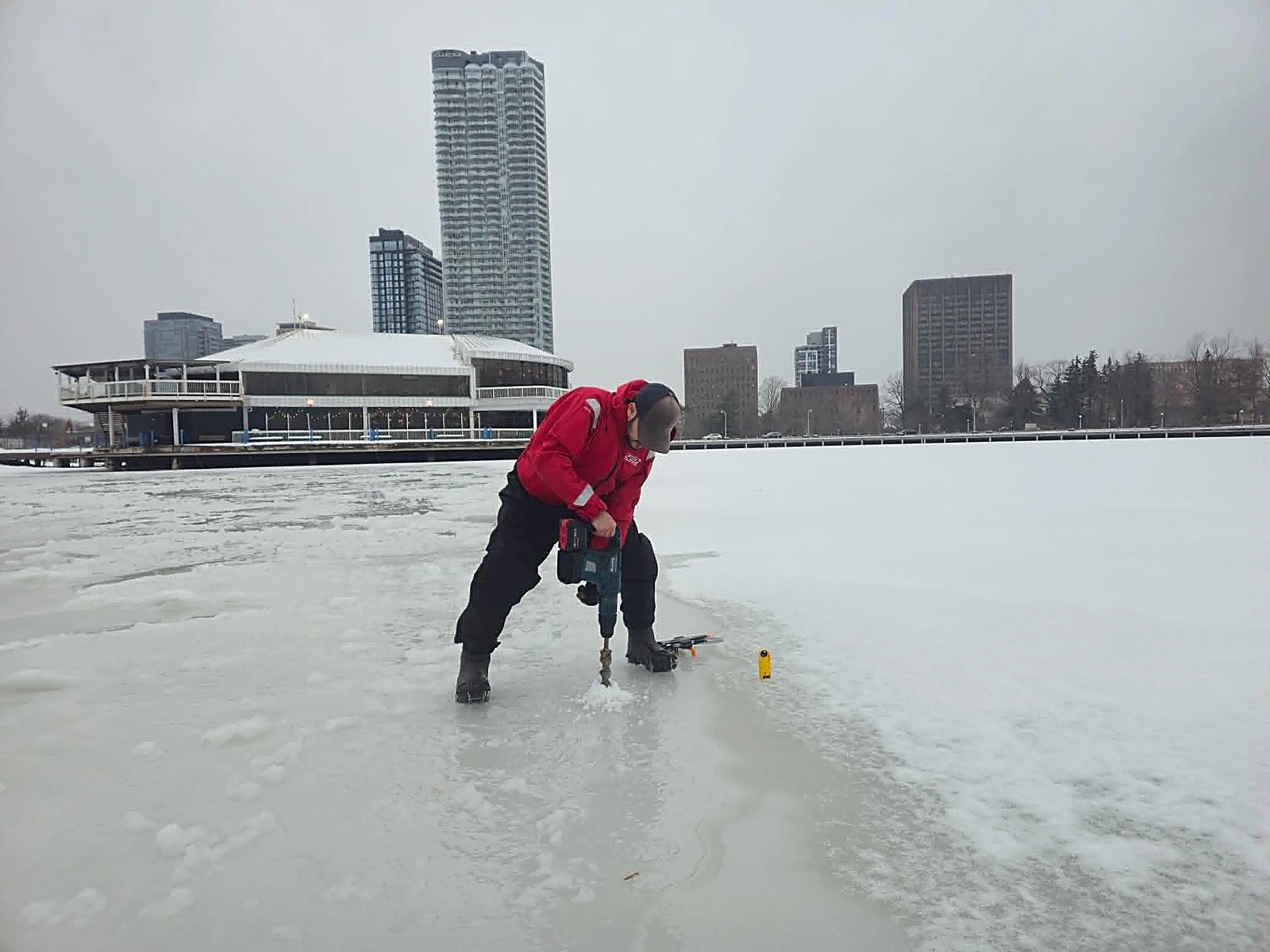
The Rideau Canal Skateway relies on an ice cover that must safely support both the public and maintenance equipment. The project reviewed the current semi-empirical approach to allowable loading and compared it with mechanics-based plate solutions to identify where simplified rules can become uncertain. The work is intentionally practical: the objective is not to replace field judgment, but to clarify which physical effects matter when operational decisions become more demanding.
Situation
Operational load decisions are commonly related to ice thickness through empirical relationships, yet real ice covers also vary in quality, temperature, boundary support, load duration, load footprint and defect condition.
Task
Assess the strengths and limitations of current bearing-capacity practice for the range of ice thicknesses and maintenance loads relevant to the Skateway and identify opportunities for higher-confidence assessment.
Approach
Compare Gold-type empirical relationships and recommended practice with analytical plate-mechanics solutions, including Wyman/Kerr-type formulations. Evaluate the role of load radius, characteristic length, stress concentration and shoreline or canal-wall boundary conditions, while documenting uncertainties that are not captured by thickness alone.
Result / client value
The study showed why empirical methods remain useful operational tools while also identifying conditions where they can be incomplete or comparatively non-conservative, particularly for lighter loads and constrained ice covers. The client value is a clearer basis for evidence-based operational thresholds, field verification and future numerical or monitoring improvements.
Why it matters
Related work
ShearLine can support owners directly or work as a specialist partner within a larger engineering team.