
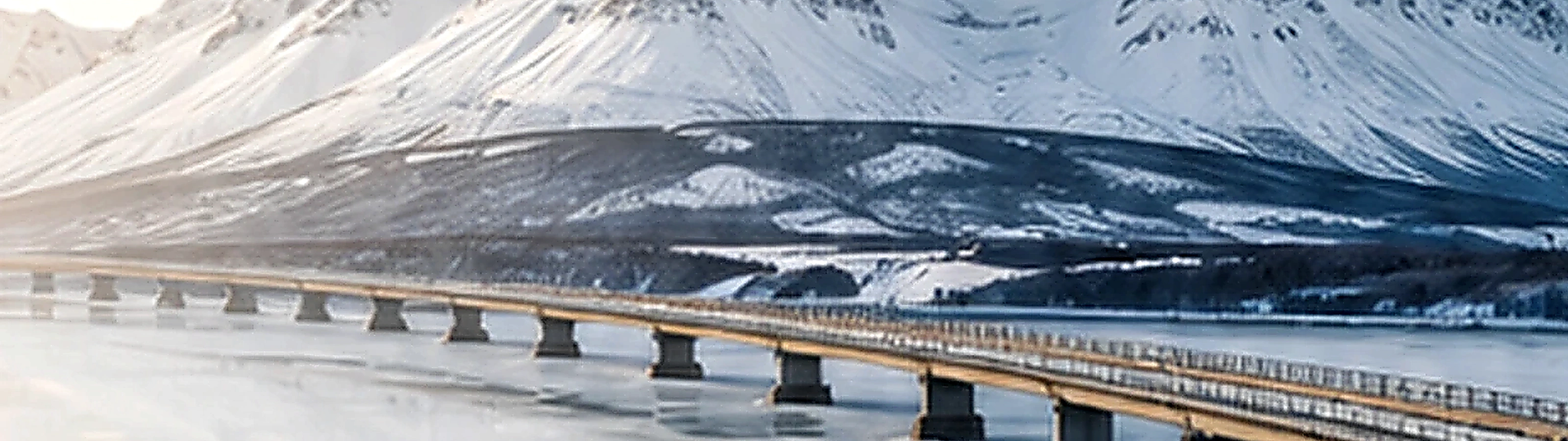
Integrated technical delivery
A single technical workflow that can carry a problem from scoping and evidence review through analysis, mapping, interpretation and decision support.
Our Company
ShearLine brings engineering, applied science, data and modeling together to help infrastructure owners and project teams make better decisions in cold, remote and changing environments.
Our Company
ShearLine is a specialist engineering, consulting and applied-science practice serving infrastructure owners, public agencies, engineering firms and industry. Our work is focused on complex environments where ground, water, ice, climate and infrastructure interact — and where understanding those interactions is essential to making a sound engineering decision.
We combine engineering judgment with field-program strategy, partner-acquired sensing and monitoring data, numerical modeling, spatial analysis and technical interpretation. The result is an integrated workflow that can support anything from a focused independent review to a turnkey technical work package.
Our objective is simple: reduce uncertainty, make the problem understandable and give clients a practical path forward.
What We Provide
ShearLine can lead a defined technical work package or integrate as a specialist within a larger multidisciplinary team. The level of involvement is matched to the project.
A single technical workflow that can carry a problem from scoping and evidence review through analysis, mapping, interpretation and decision support.
Field-program strategy, integration of partner-acquired monitoring and geophysical data, quality review, interpretation and engineering context.
Numerical engineering, GIS, terrain analysis and model-data integration used to quantify mechanisms, scenarios, hazards and performance.
Clear technical recommendations for owners, operators and engineering teams — focused on risk, lifecycle performance, monitoring priorities and practical next actions.
What We Specialize In
Our specialization is not one isolated discipline. It is the interaction between physical processes, infrastructure performance and the evidence needed to make a defensible decision.
Frozen and thawing ground, active-layer processes, thermal regimes, ground ice and infrastructure response.
Floating ice, ice roads and working surfaces, bearing capacity, defects, GPR-supported assessment and ice mechanics.
Railways, highways, remote access and utility corridors where terrain, water, climate and operations interact.
Surface water, groundwater, drainage, erosion, sediment, environmental monitoring and infrastructure-related water hazards.
Finite-element, finite-difference, thermal, hydraulic and coupled process models for problems that cannot be reduced to one equation.
GIS, remote sensing, terrain analysis, risk surfaces and spatial visualization that make complex evidence easier to act on.
The Solutions We Propose
We structure analysis around the decision the client actually needs to make. That keeps technical effort proportional, recommendations traceable and project value visible.
Define the decision, assemble the available evidence, identify the controlling interfaces and design the technical program around the actual mechanism — not a generic checklist.
Use targeted analysis, modeling, mapping and monitoring data to separate signal from noise, test scenarios and identify where uncertainty materially affects the decision.
Translate results into practical recommendations: targeted investigation, monitoring, mitigation, adaptation, operational thresholds, maintenance priorities or the next engineering decision.
Why ShearLine
We are built to solve non-routine problems without forcing every project into the same delivery model.
We connect the scope, evidence, analysis, maps and recommendations so the client is not left stitching together disconnected technical outputs.
Our strongest work sits between disciplines — frozen ground and groundwater, ice and loading, terrain and infrastructure, monitoring and numerical prediction.
Models and datasets are tools, not the final product. We focus on recommendations that improve safety, reliability, investigation efficiency, lifecycle planning and project decisions.
Our Team

Perry Godse is the founder of ShearLine and leads the firm’s cold-regions engineering and applied-science practice. His work focuses on infrastructure in complex environments, particularly permafrost and frozen ground, ice engineering, hydrology and hydrogeology, terrain and spatial analysis, and numerical modeling.
His role is to connect evidence to engineering decisions: defining technical programs, integrating multidisciplinary data, interpreting mechanisms and uncertainty, and translating modeling and spatial analysis into practical recommendations for owners and project teams.
ShearLine is structured to work directly with clients and to integrate with trusted engineering, environmental, geophysical, surveying, instrumentation and field partners when a project requires broader delivery capability.
Built for Partnership
Focused support for asset owners, operators and public agencies.
Specialist subconsulting within larger engineering and project teams.
Field acquisition and complementary disciplines coordinated through trusted specialists when required.
Have a complex problem?